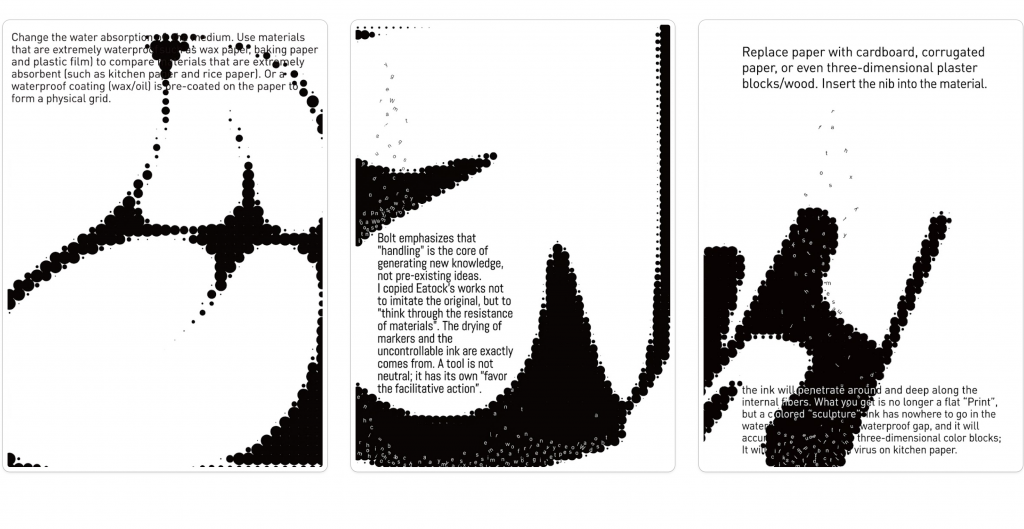
Unit 1 Proiect 2 · Methods of cataloguing
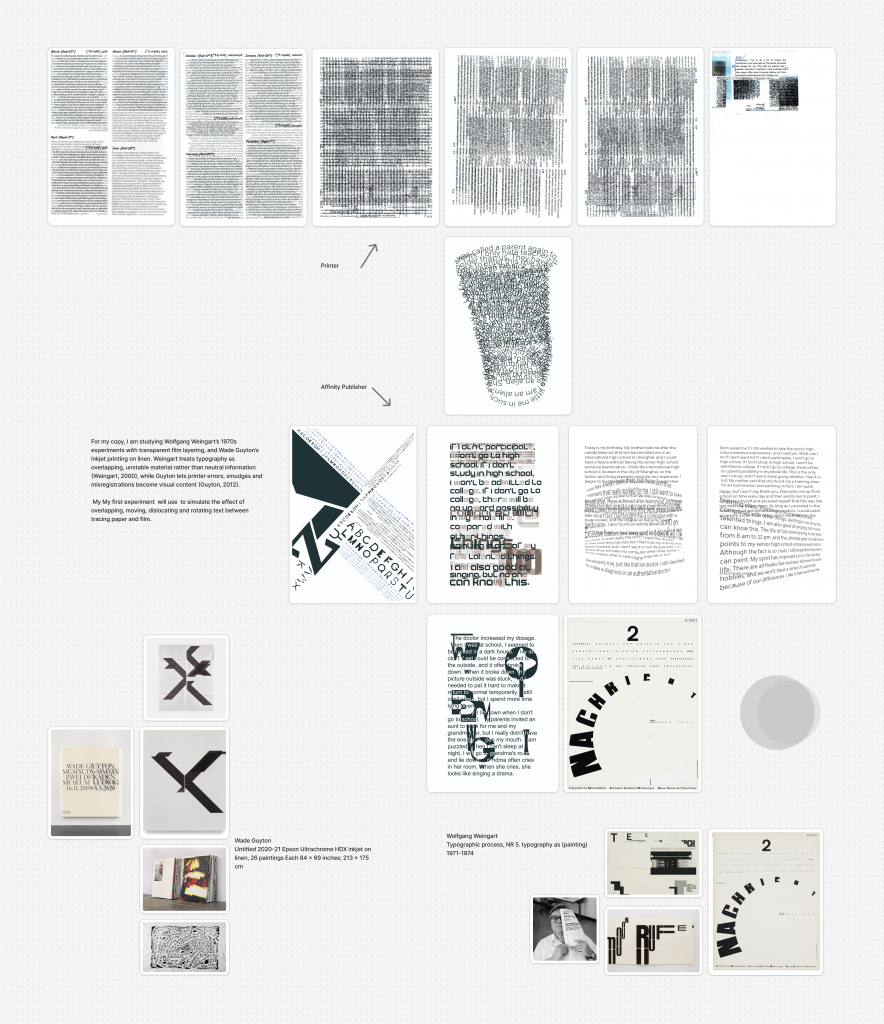
At the beginning of this project, I studied Wade Guyton’s [Untitled 2020–21 Epson Ultra Chrome HDX Inkjet on Linen, 26 Paintings each 84× 69 inches; 213 × 175 cm] and Wolfgang Weingart’s [Typographic Process], I found that I was interested in the “unexpected” effect caused by a tool. Earlier in the first week, I chose to redo Wolfgang Weingart [typographic process, NR 5. typography as (painting) 1971-1974] with ——Affinity, a software I had never touched before. I found that it was actually similar to Adobe. It’s just that when making the negative space of the replica, it’s different from Adobe’s logic of drawing graphics directly. It needs to overlap two graphics and cut off the non-overlapping parts to meet the plastic requirements, which leads to the replica being slightly different from the original in some details. Then I printed out my copy later in the first week. I found that the white background displayed on the computer would turn gray-green after printing, and the black font would turn dark green again. According to this problem, I set up a set of control experiments:
Experiment 1 printed the same document with different printers.
Experiment 2 sets different transparency and color modes but prints with the same printer.
Experiment 3 ensures the consistency of file settings and printers, and uses different materials of paper for printing.
Finally, it is known that these three variables have changed the results. At the end of the first week, I finally realized that what I was really interested in was the unpredictable influence of tools on graphic design.
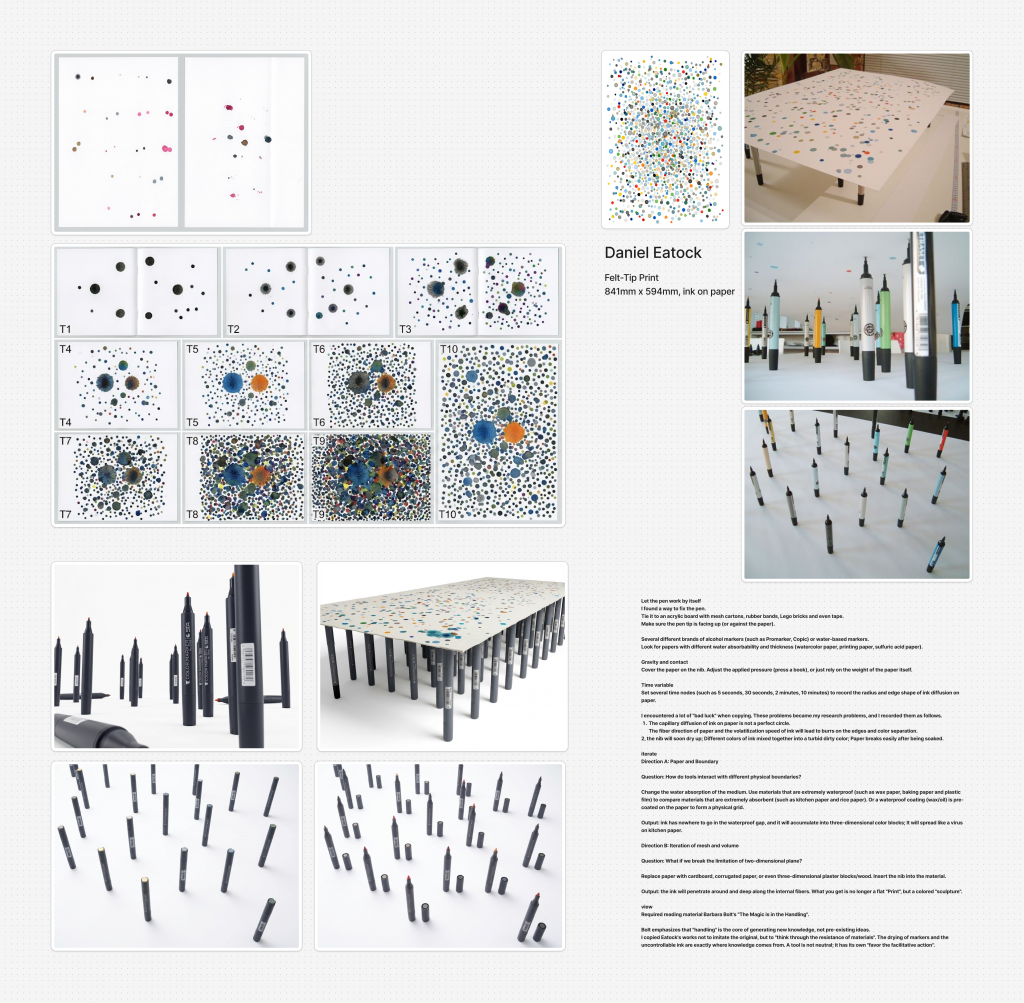
At the beginning of the second week, I studied Barbara Bolt from the reading list. His theory of “The Magic is in the Handling” coincided with my research direction. I began to study the working principle of printers, and I began to conceive how to make printers work by themselves. I was curious about the results. When I began to study the working principle of inkjet printer, I found that its interior is like many tiny syringes. Normal printing can be realized by controlling the amount and color of ink flowing through the syringes. I think this is very similar to the principle of screen printing, which is to control the ink to flow through tiny holes to leave the desired graphics on the paper. According to this idea, I found Daniel Eatock in the recommendation list, and his work [Felt-tip print 841 mm x 594 mm, ink on paper] inspired me a lot, and I made a copy of it. My replica follows the principle of controlling three different variables-time, pressure and material. Similarly, I also set up a set of control experiments:My replica follows the principle of controlling three different variables-time, pressure and material. In the same way, I also set up a set of control experiments:
Experiment 1 uses seven kinds of paper with different materials to contact the pen tip under the condition of ensuring the same contact time and pressure between each material and the pen.
Experiment 2 different pressures (such as a book, a ceramic cup and a mobile phone case) were applied to the back of the paper under the condition of ensuring the same material of the paper and the same contact time between the paper and the pen.
Experiment 3 the paper was allowed to stay for 30 seconds, 1 minute, 1 hour, 12 hours and 72 hours respectively under the condition of keeping the pressure and paper material unchanged.
The final conclusion is consistent with my original guess:both have influence and varying degrees.
In the third week, I came into contact with the artist Xavier Antin, whose early work [Printing at Home] brought me new inspiration on the road of iteration, and I began to try to deliberately destroy the printer to make a copy of Printing at Home. Like last two weeks, I set up my experiment:
Experiment 1 uses three different printers to print the same picture on different materials of paper according to the unified process.
Experiment 2 uses the same printer to load different inks for different papers to print the same picture.
Experiment 3 the same picture was divided into four different layers according to the color of the printer’s ink cartridges, and the same picture was printed with the same paper for different ink cartridges. In the above experiment, I will randomly “destroy” any ink/cartridge/nozzle (for example, replacing ink with coffee liquid/coating nozzle with apples or lemons/stamping paper with cut potatoes).
The result was unexpected: under the condition that I controlled the variables, the unchangeable things also brought me unexpected results. So I began to explore the effects of those tools when they worked by themselves. In the process, I recorded the following questions and set up experimental groups for them one by one:
- How does the humidity of paper affect the ink adhesion?
- Will the pressure of potato stamp cause paper jam or misplacement of print head?
- In which part of the printer’s standard process was completely disrupted?
Before doing the experiment, I made some guesses based on the experimental results of the questions I was interested in: First, I guess that when the paper is wetter, the hardness of the paper will decrease, and the adhesion ability of ink will increase, so the printed picture may produce uncontrollable ink smudge with the superposition of layers. Secondly, I guess that potatoes, as a starch-rich medium, should have a great influence on the smoothness of paper after being cut as a seal, so the printed pictures will be uneven and many places can’t be inked. Finally, I guess there will be an accident in the middle and early stage of printing, which will make the printer unable to complete the printing work according to the normal process. But the display of the results opened my eyes.
The result of Experiment 1 showed that the ink didn’t smudge as I expected, which may be because the ink itself has the property of quick drying and the printing result is surprisingly perfect because of the high smoothness of the paper, and only a small number of ink droplets splash on the periphery of the main image.
The results of experiment 2 show that the existence of starch in potatoes really affects the printing effect of pictures, but because the cut potatoes will also dry with the passage of time, the initial seal will only leave most of the water and a small part of starch on the paper, which will change more the humidity and hardness of the paper than the smoothness. Then, as the potato incision dries, more and more starch is stacked on the paper. The humidity of the lower paper is too high, and the starch on the upper layer becomes dry and has strong water absorption, so that the ink is quickly introduced into the wet paper after passing through the starch, but the effect is similar to the result of Experiment 1, as I guess-the image is smudged and spread out.
The results of experiment 3 can be judged by the results of the above two experiments and the printing effect of the final picture. The result is that the printer was completely disrupted in the middle and late stage of the workflow.
Through my in-depth research into Xavier Antin, I discovered that the imagery he employs in his Printing at Home series—drawn from the era of the Industrial Revolution—was not chosen at random. I believe Antin intentionally links these visuals to the technical nature of the printer itself and to metaphors concerning the displacement of human labor. Many of the images he selects depict the Industrial Revolution—a period when the automation of looms allowed even low-skilled workers to operate machinery, a shift that, as historical records show, incited the Luddites to protest by smashing the machines. I interpret Antin’s decision to present these historical images—layered and stacked through the printing process—as a gesture that implies the disruption and subversion of standardized technological products. By drawing a parallel between this “intentional sabotage” of the printer and the historical resistance of workers against automation, Antin not only explores the impact of technological change on social structures but also unearths an overlooked technological lineage, while offering a critical examination of what automation signifies for labor. This insight has proven to be the most valuable takeaway from my research into his work, and it now serves as a core conceptual pillar for my own project in its current iteration.
The detailed map can be viewed as follows:
https://www.figma.com/board/ByRnMuNby2rewW0y1zrCUS/Unti-1-iterating?node-id=0-1&t=CyYIjrZE0yw1wpHS-1
Leave a Reply